
At the recent American Society of Gene & Cell Therapy (ASGCT) Annual Conference that took place in Boston, MA, Hélène Tran, Director and Head of Antisense Oligonucleotide (ASO) Programs at Servier, gave a presentation titled “ASO Developer Journey: From Gene to Medicine and Data to AI”, outlining how Servier’s team is addressing the complexities of drug discovery in the rare neurological disease space. This challenge is driven by a compelling reality: of the 300 million people globally living with a rare condition, 50% have a debilitating neurological component. Currently, less than 10% of rare patients receive disease-modifying treatments.
At Servier, advances in genetic diagnosis enable us to focus our research on disease root cause and developing precise and targeted therapies for genetically defined patient populations. However, the path to a viable therapy requires navigating significant technical and clinical hurdles, particularly in the ultra-rare disease space where patient populations are small, and disease understanding is often limited.
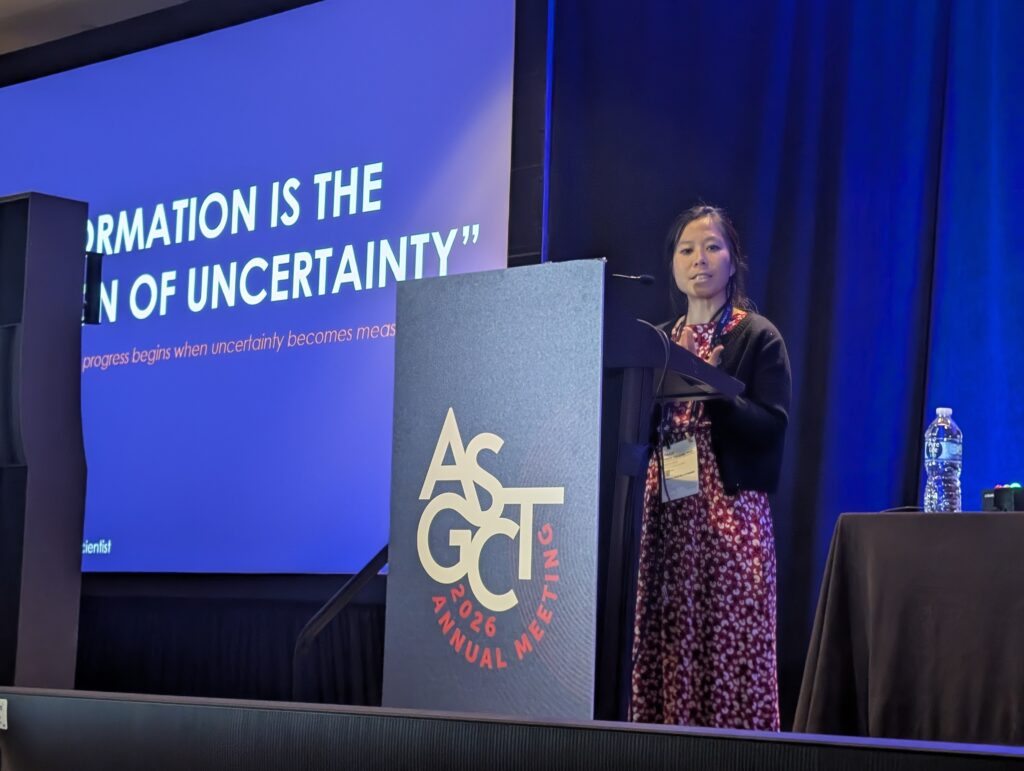
To overcome these barriers, Hélène presented our team’s advancements in developing Antisense Oligonucleotides (ASOs). This therapeutic platform is uniquely suited for neurology because it allows researchers to target the genetic cause of a disease modulating gene expression. However, the traditional “ASO journey” has historically been driven by high-volume screening: researchers had to screen thousands of compounds to find a single viable “hit” – a process that is both time-consuming and costly. To transform this empirical approach using modern tools, our research team is now integrating Deep Learning and AI modeling into the development of ASOs. By leveraging AI and data, the teams can move beyond manual trial-and-error, using predictive data to identify the most promising candidates with unprecedented speed. Our decision-making algorithm integrates a non-exhaustive range of factors in silico, such as, animal model homology, off-target characterization, and molecular structures. By incorporating these parameters computationally at an early stage, we significantly mitigate failures throughout the drug discovery process, ensuring more robust candidates move forward.
This AI-driven acceleration is already translating into concrete clinical results. A prime example is our ASO program targeting KCNT1-related developmental epileptic encephalopathies (DEEs) – a group of ultra-rare, drug-resistant epilepsies characterized by profound impairment and high mortality in early childhood. By integrating AI into our ASO platform to design and optimize therapeutic candidates, our teams were able to streamline the discovery process and accelerate the path to the clinic. This program has now transitioned from early research to in-human trials, with the first patients dosed in Europe as part of the Phase 1b/2a Kandle study. This milestone represents a critical step forward for a patient population that currently has no approved disease-modifying therapies.
As Hélène highlighted during her session, these advancements are not the result of a single initiative, but rather the collective effort of the entire R&D departments teams dedicated to advance ASO therapeutics.
A special huge thank you to Thierry Dorval, head of Data Sciences & Data Management research Unit, Sofia Lotfi and Majd Saleh for their dedication to bringing innovative solutions to patients with high unmet needs.